Organising wind industry training in context, on a wind turbine at sea, can incur high costs from transport, powering down equipment and team downtime. It can be easily disrupted by adverse weather and presents logistics challenges when trying to organise groups to train together. With fewer opportunities to train or upskill, skills fade can occur, particularly in uncommon operations or emergency situations.
In training centres onshore, facilities aren’t always available to give trainees an accurate experience of real-life offshore conditions, and the need to take turns using equipment can mean limited time is actually spent practising skills.
A lack of offshore wind training centres or available instructors to meet demand, particularly in emerging markets, can impact the availability of a skilled workforce to meet employers’ needs. A lack of exposure to the reality of an offshore environment can also lead to dropouts among recent graduates or students entering the wind industry.
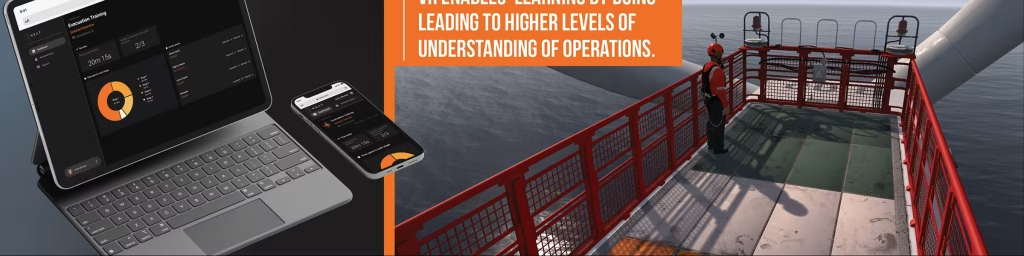
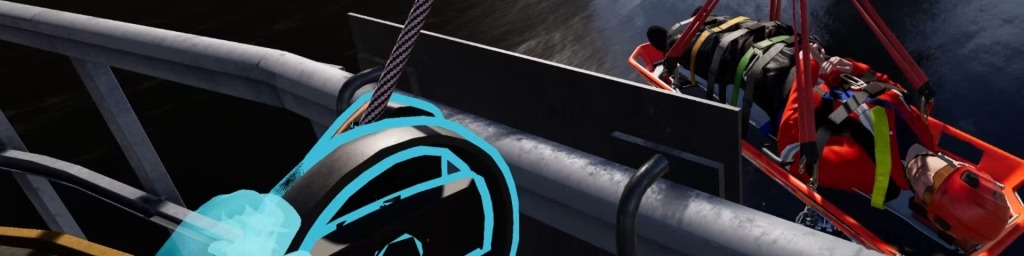
HEAT for Offshore Wind is a groundbreaking solution that integrates virtual wind farm simulations with a powerful data capture and analytics platform. Within these highly realistic, interactive virtual environments, complex training scenarios can be created for a range of technical operations and safety or emergency situations. Wearing portable VR headsets, wind turbine technicians and other offshore workers can learn and practise skills as many times as necessary. The headsets can be used almost anywhere, reducing the need to travel for training purposes while providing a means of easily maintaining or topping up skills.
Our specialist wind technician training system captures up to 500,000 data points per minute, and analyses the information to present insights about the trainee’s performance via a user-friendly dashboard. These insights can be tailored to capture the most relevant success factors in each situation, providing objective, detailed information that trainees, instructors and managers can use to improve overall outcomes
VR offshore wind training provides a safe, authentic and measurable way for the offshore workforce to learn, practise and demonstrate the skills essential to working in this unique and challenging environment.
Learners trained using virtual reality simulations are up to 40% more confident to act on what they’ve learned than after classroom-based training alone, and 35% more confident than after e-learning.
VR training is up to 4 times faster than traditional training, not including the time saved through the reduced need to travel to and from training centres. By reducing travel and overnights, carbon emissions and overall training costs are also reduced.
It can be rapidly scaled across a growing workforce, with the HEAT dashboard providing an effective, digital tool to m
I led development on this project from the ground up, using C++ and Blueprints in Unreal Engine while coordinating closely with a 3D artist, designer, and QA team. The project was a VR hazard-response experience in which users had to interact with objects and NPCs in the correct order to complete their objectives, supported by contextual hint prompts throughout.
For the project development, I’m using Unreal Engine with C++ and Blueprints.
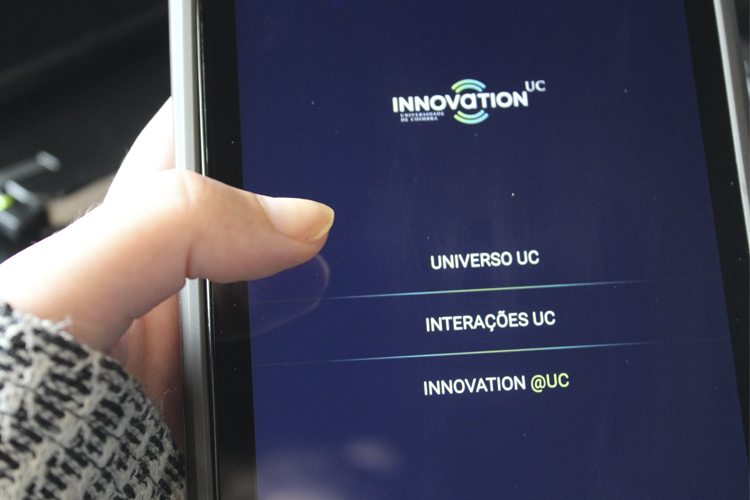
Developed an Android App to promote the different research centres of the University of Coimbra
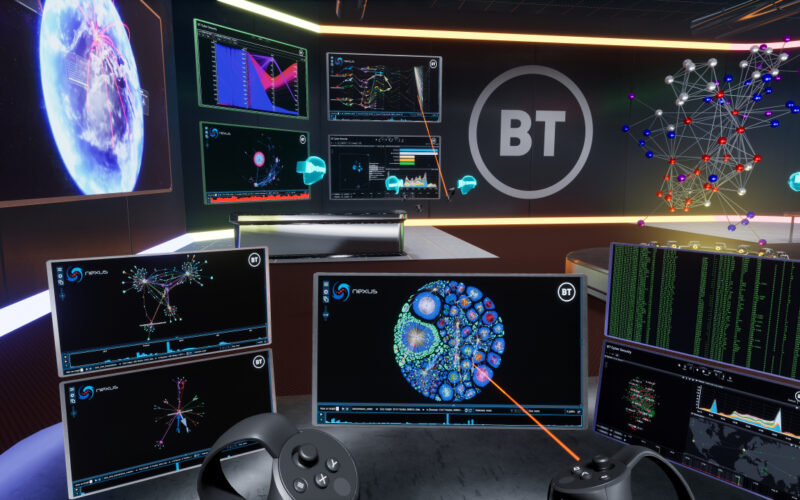
VSOC it’s a ongoing research project combining VR with Cyber Security. It aims to get analysts fully immersed in their experience of analysing big data.
My dissertation on Cybersickness when using VR devices. The work carried out as part of the internship at Mimicry Games.
© Tiago Martins Andrade. 2021. All Rights Reserved.